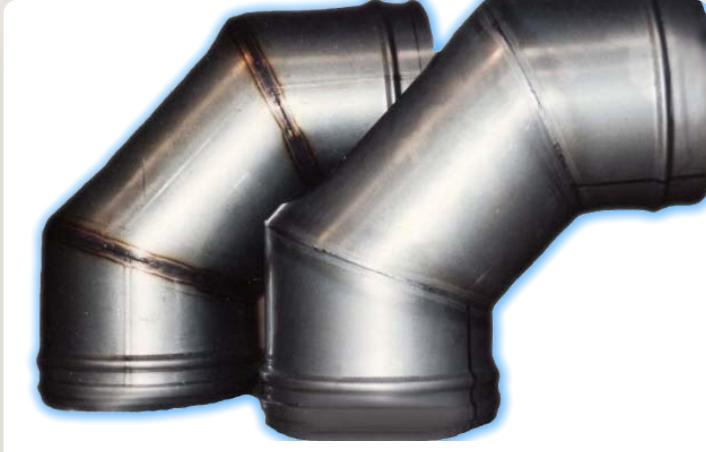
The thermal oxides from any heat treatment process and welding are mainly iron oxides of various states. They will readily corrode and in almost every application will contaminate product material with which they contact. The removal of these oxides is paramount in order to maintain the surface properties of stainless steel.
Typical scale composition of weld oxides includes a hard outer layer of Fe₂O₃, a sandwich layer of Fe₃O₄, a softer base layer of FeO, and then the base material. The upper hard layers are far more difficult to chemically dissolve and mechanically remove.
Methods
There are several methods and techniques in which pickling and descaling is carried out:
- Localised pickling with paste and gel, applied by brush or spray
- Immersion pickling, where the whole or part of the item is immersed into a tank
- Anodic etch / pickle, an electrolytic method employing solutions in a tank with a rectifier
Simple stainless steel surface pickling is carried out with Anokap Pickle 180 / 181. Pickling is often followed by passivation and desmuting so the chromium-rich passive film can form properly on the restored surface. Download the Pickle 180 / 181 data sheet.